








Say the name Quasimodo and most people picture the same thing: a hunchbacked bell-ringer swinging high above Paris in the towers of Notre-Dame Cathedral. That image comes from Victor Hugo’s great novel, and it is the meaning everyone knows first. But the name really covers three different things, and the full story is stranger and richer than the Disney version most of us grew up with.
In this guide, you will discover what the name means in each of its senses, meet the character as Hugo wrote him, learn why he was given that odd name, find out whether he was based on a real person, and meet the Nobel-winning poet who happens to share his name.
What Does Quasimodo Mean?
Depending on context, the name can point to three entirely different things. Here they are at a glance; the rest of the article walks each road in full.
| Meaning | What It Is | Key Fact |
|---|---|---|
| The fictional character | The deformed bell-ringer in Victor Hugo’s novel The Hunchback of Notre-Dame | Published in 1831; the story is set in Paris in 1482 |
| Quasimodo Sunday | The first Sunday after Easter in the Christian calendar | Named from the opening Latin words of its Mass; this feast day is why Frollo gave the child his name |
| Salvatore Quasimodo | Italian poet (1901-1968) | Won the Nobel Prize in Literature in 1959 |
Quasimodo the Character in Hugo’s Novel
Who Is Quasimodo?
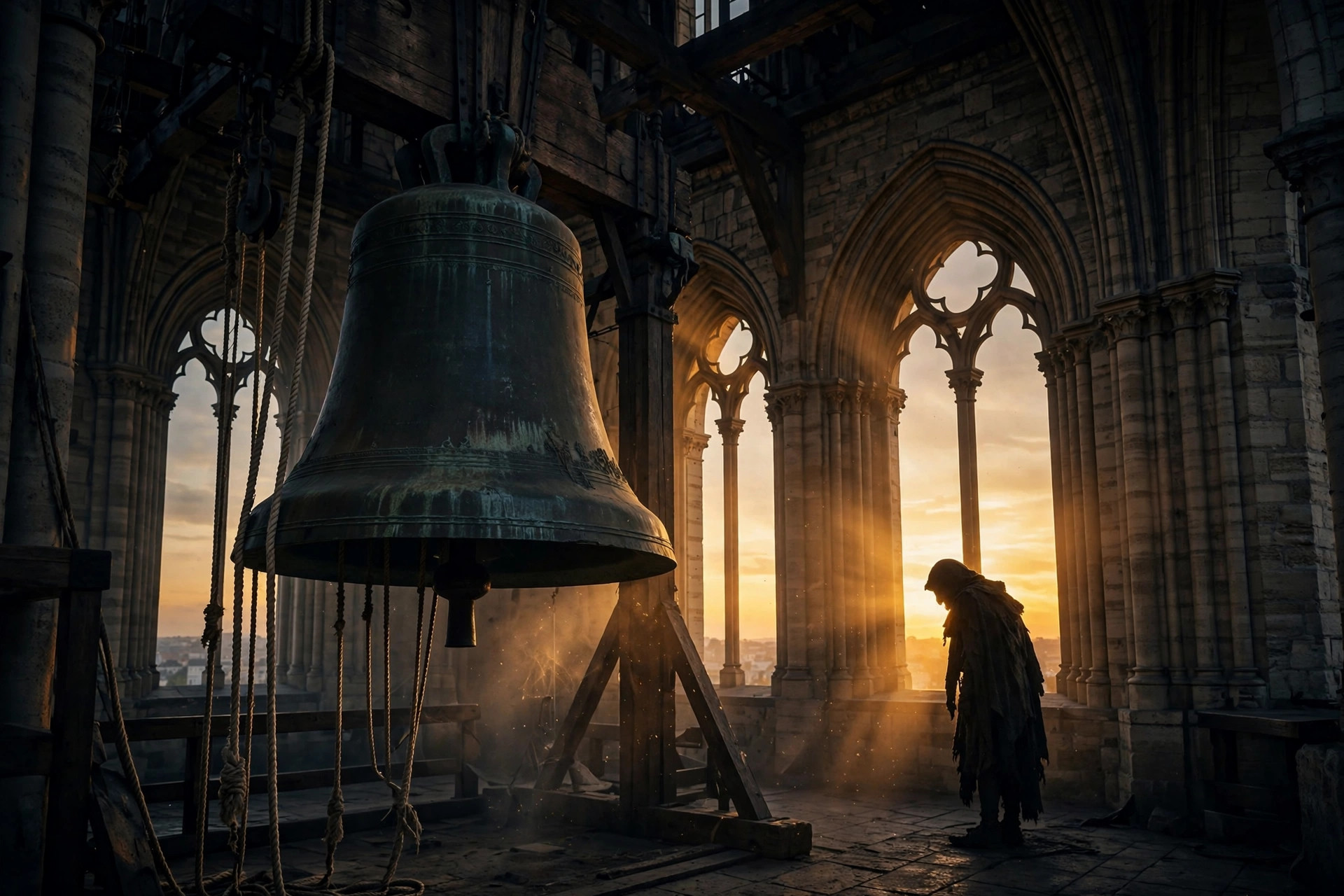
Quasimodo is the central figure of Notre-Dame de Paris, Victor Hugo’s 1831 masterpiece known in English as The Hunchback of Notre-Dame. He serves as the bell-ringer of Notre-Dame Cathedral in Paris in the year 1482. Hugo describes him bluntly: a severe hunchback, a face dominated by a great wart, one eye nearly hidden, teeth broken and jutting. Crowds call him hideous, and he has heard it so long that he half believes it.
The great bells left him almost completely deaf over the years, so his guardian Claude Frollo taught him a form of sign language. Deafness cut him off from people even further, and he withdrew into the towers, where his only real company was the bells he loved and the stone gargoyles watching over Paris. Yet Hugo insists that inside the ruined body lives a gentle and faithful soul. He loves completely and forgives rarely, and once he gives his loyalty, nothing shakes it.
As an infant, he was left on the foundlings’ bed of Notre-Dame, the wooden bed where unwanted babies were abandoned to public charity. Claude Frollo, the archdeacon of the cathedral, took him in and raised him to ring the bells. He grew up believing Frollo was the only person in the world who cared for him, a belief Frollo used without mercy.
Why Is He Called Quasimodo?
The baby was discovered on the cathedral steps on Quasimodo Sunday, the first Sunday after Easter. Frollo named the child after the feast day of his finding, a common custom of the time. The name stuck for life and then for centuries of literature after it.
In Disney’s 1996 film, Frollo tells the infant’s story differently, saying the name means “half-formed” in Latin. That definition is the film’s invention, but it fits so neatly that many viewers accept it as fact. In Hugo’s novel, the explanation is simpler and more poetic: the boy is named for the holy day that delivered him to the church door.
Quasimodo and Esmeralda: The Story in Brief
The emotional core of the novel is his devotion to Esmeralda, a beautiful and kind Roma dancer of sixteen. Near the start, Frollo commands him to kidnap her. The attempt fails, he is captured, and a deaf judge sentences him to be flogged and displayed in the pillory. Tied up before a jeering crowd and dying of thirst, he begs for water. A child throws a wet rag at his face. Then Esmeralda pushes through the crowd and holds a cup to his lips.
Hugo gives that moment a famous line: “a tear for a drop of water.” One small mercy remakes his heart, and from that hour his life has a single purpose: to protect her.
When Esmeralda is later condemned to hang for a murder Frollo himself committed, he watches from a high balcony as she is forced to pray on the cathedral steps. He slides down a rope, sweeps her into his arms, carries her back up into Notre-Dame, and shouts “Sanctuary!” to the crowd below. For a brief time she is safe in the tower, and he guards her with a tenderness he has never shown anyone.
There is a quiet scene Hugo uses to explain the novel’s whole moral. He sets two vases in Esmeralda’s room: one a beautiful crystal vase holding dry, withered flowers, the other a plain clay pot overflowing with fresh, fragrant blooms. The crystal is the handsome Captain Phoebus, whom Esmeralda loves and who will abandon her. The clay pot is the bell-ringer himself.
The ending refuses comfort. Frollo tricks Esmeralda out of sanctuary and she is hanged. Watching from the tower, he sees Frollo smile at her death. In that instant his lifelong obedience snaps, and he hurls his master from the balcony. Then he walks out of Notre-Dame forever, finds Esmeralda’s body where it was thrown, lies down beside it, and dies of hunger with his arms around her. Years later, when workers open the grave, the two skeletons are found intertwined, and his bones crumble to dust the moment they are touched.
Was Quasimodo a Real Person?
The character is fiction, but the man who inspired him may have been real. In 2010, British archivist Adrian Glew was studying the autobiography of nineteenth-century sculptor Henry Sibson when he found a striking passage. Sibson described working at Notre-Dame in the 1820s alongside a hunchbacked stone carver, a laborer hired for the cathedral’s restoration.
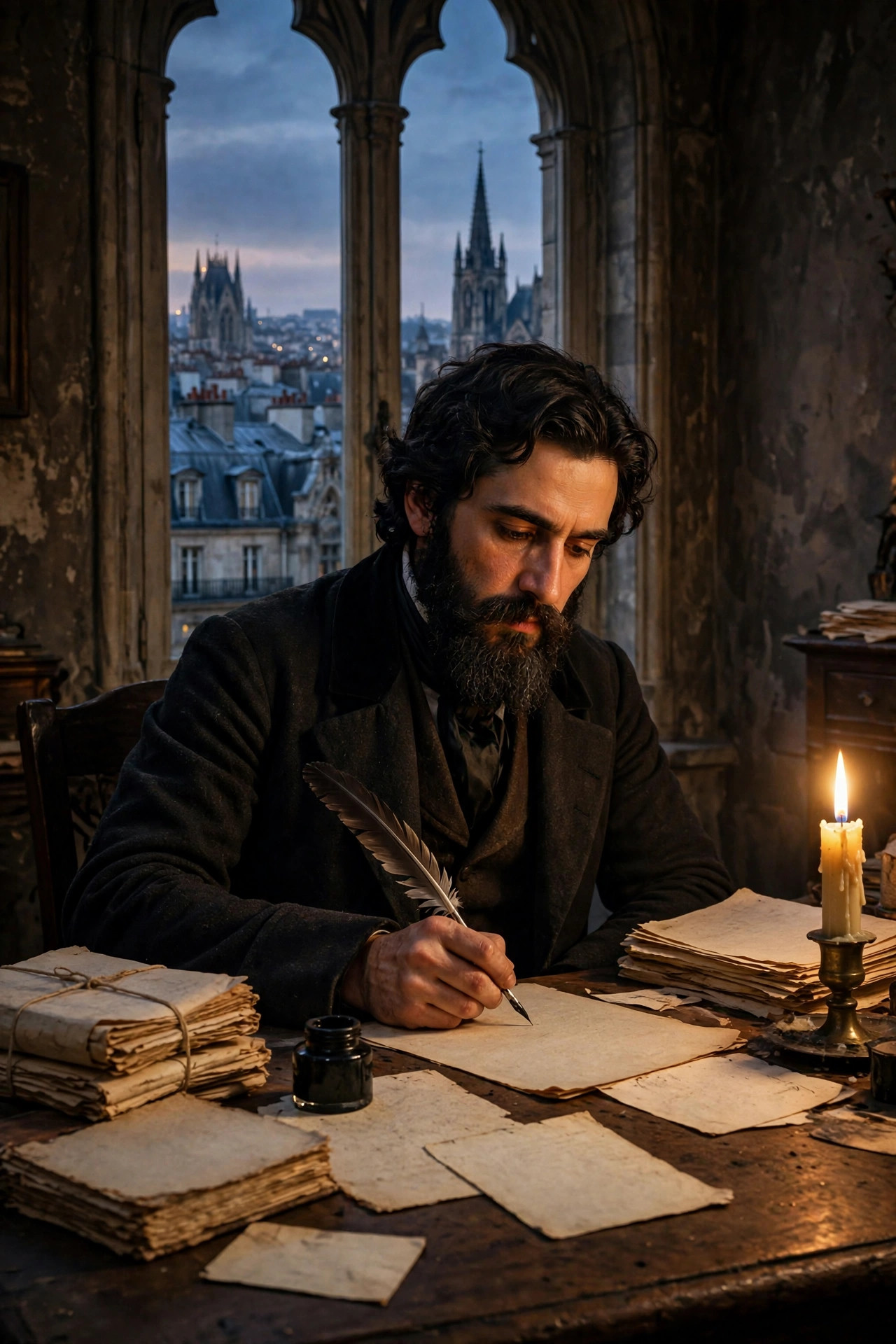
Victor Hugo haunted Notre-Dame while writing his novel, sketching gargoyles and soaking in the building’s atmosphere. The dates overlap neatly with Sibson’s account, so it is entirely possible that Hugo saw the hunchbacked carver at work and stored the image away. Sibson even names another sculptor, Trajan, in the same pages, and Paris archives confirm a sculptor of that name working in the 1820s, which supports the memoir’s reliability.
No one knows the real carver’s name, and there is no evidence he rang bells or lived in a tower. But the discovery gives Hugo’s creation a human root: behind the most famous hunchback in literature may stand a forgotten workman with a chisel.
Quasimodo Sunday: The Church Day Behind the Name
What “Quasi Modo” Means in Latin
Quasimodo Sunday takes its name from the introit, the opening chant of the Mass celebrated that day. In Latin it begins “Quasi modo geniti infantes,” which translates as “As newborn babies.” The words come from the New Testament, 1 Peter 2:2, and they address Christians newly baptized at Easter, welcoming them as infants in the faith.
The Sunday is the first after Easter and closes the Easter octave, the eight-day festival of the Resurrection. In the old tradition, each Mass took its popular name from the first word of its introit, the same custom that gave us Gaudete Sunday and Laetare Sunday. That is how a quiet spring Sunday ended up lending its name to literature’s most famous bell-ringer.
Its Other Names
Few days in the Christian calendar carry as many names as this one. It is widely called Low Sunday, most likely because its celebration is modest next to Easter’s splendor. Its formal Latin title is Dominica in Albis, “Sunday in white,” recalling the white garments the newly baptized wore all Easter week before laying them aside. In the Eastern churches it is known as Thomas Sunday or Antipascha, tied to the Gospel story of the doubting apostle Thomas. And since the year 2000, Pope John Paul II designated it Divine Mercy Sunday.
Knowing this, Frollo’s choice of name reads differently. He did not invent a label for a deformed child. He gave the boy the name of mercy itself, the Sunday of newborns and second chances.
Salvatore Quasimodo: The Poet With the Same Name
The third bearer of the name never rang a bell. Salvatore Quasimodo was born in Sicily in 1901 and became one of Italy’s most honored poets. His early poems, written in the dense style called hermeticism, meditate on memory, solitude, and the Sicilian landscape. After the Second World War, his work turned outward toward social justice and the suffering of ordinary people.
In 1959, the Swedish Academy awarded him the Nobel Prize in Literature. If you ever encounter the name beside words like “poetry,” “Sicily,” or “Nobel,” you are meeting the poet, not the hunchback. The shared name is pure coincidence, and it is exactly why a search for the name benefits from a guide that sorts the meanings out.
Book vs Disney: Two Very Different Quasimodos
For most modern audiences, the name means Disney’s 1996 animated film, with Tom Hulce voicing a gentle, big-hearted hero. The film keeps the cathedral, the bells, and the villain Frollo, but it rebuilds almost everything else. Here is how the two versions compare.
| Hugo’s Novel (1831) | Disney’s Film (1996) | |
|---|---|---|
| The bell-ringer’s condition | Severely deformed, half-blind, deaf | Mild hunchback, speaks and hears normally |
| Esmeralda’s fate | Hanged; he dies embracing her corpse | Rescued; both survive |
| Frollo’s role | Archdeacon and adoptive father; thrown from the tower by his ward | Ruthless judge; falls to his death |
| The ending | Bleak: the lovers die, bones found entwined | Joyful: Paris accepts him |
| The gargoyles | Silent stone | Three comic sidekicks who talk |
| Core message | Fate, cruelty, and transcendent love | Inner beauty matters more than looks |
Neither version is wrong. Disney translated a brutal nineteenth-century tragedy into a family story about acceptance, and it introduced him to millions who would never open Hugo. But readers who want the real bell-ringer, the one who crumbles to dust in Esmeralda’s arms, need to meet him on Hugo’s darker terms.
Quasimodo in Pop Culture
The bell-ringer has rarely left the stage or screen for long. Lon Chaney’s 1923 silent performance, done with painful prosthetics he designed himself, made the hunchback a film icon. Charles Laughton brought him dignity in 1939, Anthony Quinn gave him fire in 1956, and Anthony Hopkins played him for television in 1982. The French musical Notre-Dame de Paris has kept the story alive for theater crowds since the late 1990s, and the character has been parodied everywhere from cartoons to comedy films.
Beyond adaptations, the name itself entered the language. To call someone “a Quasimodo” is to invoke the whole parable: a person dismissed for their appearance who turns out to hold the largest heart in the room.
Key Takeaways
The name covers three things at once: Hugo’s tragic bell-ringer, the Easter-season Sunday that named him, and a Nobel-winning Sicilian poet. The character may have been inspired by a real hunchbacked stone carver glimpsed at Notre-Dame in the 1820s. And the cheerful hero of the Disney film is a distant cousin of the doomed young man Hugo actually wrote, the one whose bones turned to dust in his beloved’s embrace.